How to Teach Music Theory Beginner A Lesson 12
Welcome to the How to Teach Ultimate Music Theory Beginner A Workbook Series - Lesson 12 - Whole Notes and How to Be a Theory Detective!
The Ultimate Music Theory Beginner A, B and C Workbook Series is the perfect theory supplement for Beginner Students (ALL ages, ANY instrument). The UMT Beginner A, B, C Series works with every Method Series and with every Learning Style.
In this Blog, we will look at how to teach the concepts in the Music Theory Beginner A Workbook Lesson 12. Remember to read the first 12 Blogs in this series:
Music Theory Beginner A Overview
Music Theory Beginner A - Lesson 1
Music Theory Beginner A - Lesson 2
Music Theory Beginner A - Lesson 3
Music Theory Beginner A - Lesson 4
Music Theory Beginner A - Lesson 5
Music Theory Beginner A - Lesson 6
Music Theory Beginner A - Lesson 7
Music Theory Beginner A - Lesson 8
Music Theory Beginner A - Lesson 9
Music Theory Beginner A - Lesson 10
Music Theory Beginner A - Lesson 11
Join me as we explore tips and tricks to incorporate theory, ear training, sight reading, and games into every lesson. Let's jump in!
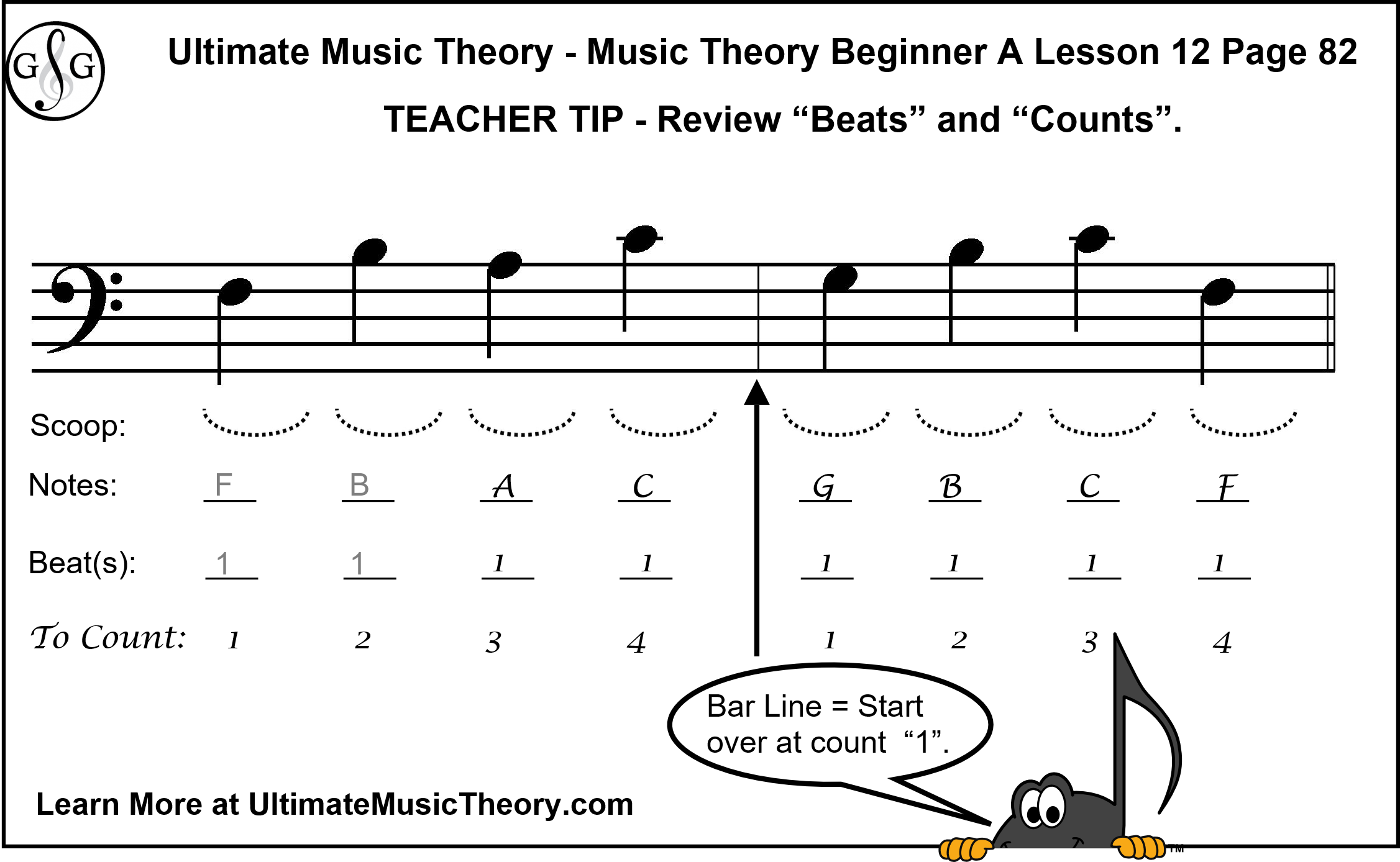
How to Teach Music Theory Beginner A Lesson 12 Page 82 - Beats and Counts
Lesson 12 Page 82 starts off by introducing the Quarter Note in the Treble Staff (using the notes from Middle C - G) and in the Bass Staff (using the notes from Bass F to Middle C).
I like to review with my Students that, even though there isn't a Time Signature at the beginning of each of these lines of music, we need to keep each measure "equal".
On this page, each of the four measures has a rhythm of 4 Quarter Notes. You can identify these as individual beats (the beat number received by each note) = 1 + 1 + 1 + 1.
When we play the melody in each measure, we would COUNT the number of beats = 1 - 2 - 3 - 4. Once you reach a bar line, you must start counting again with a "1"!
My Teacher Tip is to identify the difference between a "Beat" and a "Count".
- Beat = the steady pulse of music (think about how a clock has a steady ticking sound - this is the "Beat").
- Count = the "numerical system" (the "numbers") that musicians use to organize the beats into equal measures of time.
Yes, this is confusing. I like to review that each note has an individual "Beat". For example, a Quarter Note all by itself has 1 Beat. When you write 4 Quarter Notes in one measure, then you "Count" 1-2-3-4.
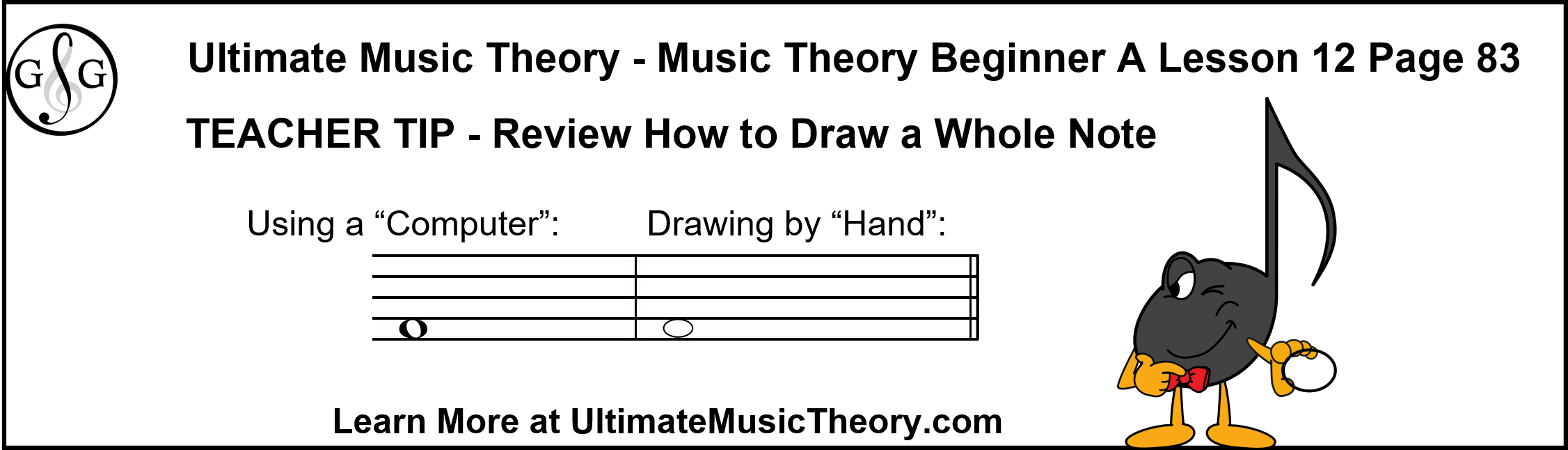
How to Teach Music Theory Beginner A Lesson 12 Page 83 - How to Draw a Whole Note
When reviewing the new note value - the Whole Note - I like to discuss what a whole note looks like. A Whole Note has a notehead that looks like an oval or a circle. It also does not have a stem.
When a Computer (or a program like Finale) writes a Whole Note, it is rather fancy with lots of shading. But we are not Computers. We do not need to write a Whole Note with all that shading.
Using your UMT Whiteboard, have your Students practice drawing that oval or circle shape (without the fancy shading).
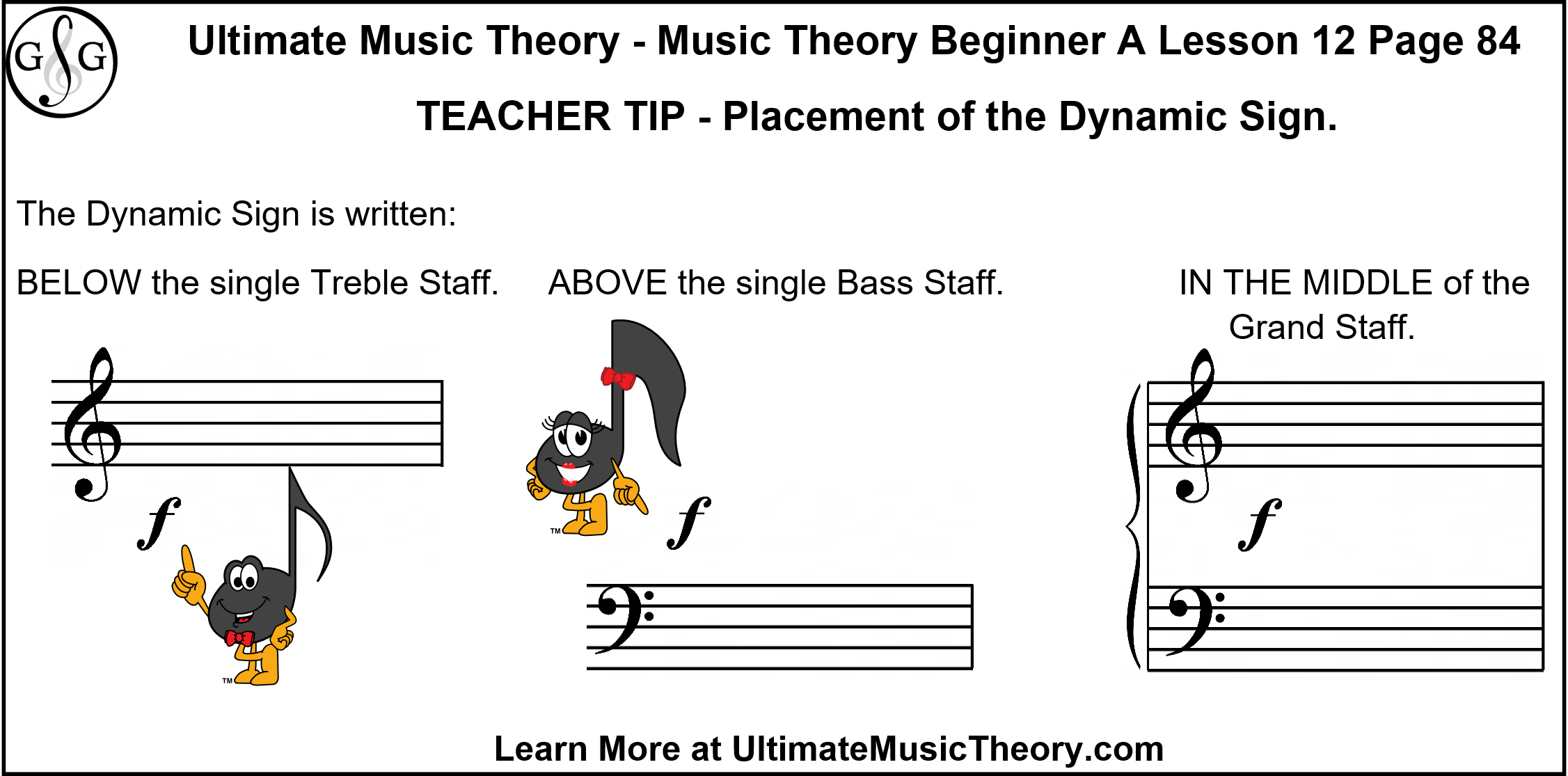
How to Teach Music Theory Beginner A Lesson 12 Page 84 - Dynamics
As we introduce Dynamics, I like to introduce the idea of becoming a Theory Detective!
Music is not just playing the notes on your instrument. On Page 84, Students learn about Dynamics, starting with forte and piano.
On this page, it is very important to review that the Dynamic Sign is written:
- BELOW a single Treble Staff
- ABOVE a single Bass Staff
Why? I explain that the reason for this is that IF you were to join the single Treble Staff and the single Bass Staff into a Grand Staff, the Dynamic Sign would be in the MIDDLE of the Grand Staff (below the Treble Staff and above the Bass Staff).
How to Teach Music Theory Beginner A Lesson 12 Page 85 - How to Be a Theory Detective
When we act as "Theory Detectives", we analyze our music before we play it Page 85 is a great example of what clues in the music help us. Grab any music book that your Student is currently playing from. Open to any piece of music and experiment being a "Theory Detective".
What Clues would you look for? I like to start at the very beginning of the first staff and look for:
- CLEF Sign - is it in the Treble Clef or the Bass Clef?
- BEATS - how many beats are in each measure?
- PITCH - are the notes starting down low, in the middle or up high?
- NOTE VALUES - what kind of notes are in each measure?
- DYNAMICS - what is the volume of the sound going to be?
All of these Clues will help us play properly.
How to Teach Music Theory Beginner A Lesson 12 - Celebrating Completing our Workbook
As your Student finishes their UMT Music Theory Beginner A Workbook, how do you celebrate?
- I like to make certain that all the corners have been clipped. As previously discussed, I love using "Clipped Corner Jars" to store these clipped corners. My students each have their own "Clipped Corner Jars", and we add up their clipped corners at the end of the year to earn a prize. Another Teacher I know prefers to put all the Clipped Corners into one big jar that sits on top of her piano. This is the "Studio Clipped Corner Jar" and students enjoy adding to it throughout the year.
- I like to have my students put a "big sticker" on the front of their Music Theory Beginner A Workbook. This means that the Workbook is FINISHED!
- I love to complete the Certificate on Page 87. If I have a Media Permission for that Student, I take a picture of the Student with their Certificate and post it on my Studio's Facebook Page.
- Make certain all the Flashcards have been cut out. I put them in a Ziploc Baggie. These Baggies can either stay in the Student's music bag OR (for students who frequently forget their music books at home) they can stay in the Studio. This way, when a student forgets their books, we can play Flashcard Games as part of our lesson.
If you do anything else to celebrate your Student's Success, please share it below! I love hearing how other Teachers make their Students feel proud of their accomplishments.
And now, the adventure continues with UMT Music Theory Beginner B!
With a Smile and a Song,
Shelagh McKibbon-U'Ren
The Ultimate Music Theory Workbook Series - Beginner A, B, C, Prep 1, Prep 2, Basic, Intermediate, Advanced and Complete all-in-one Rudiments!

The UMT Workbooks include 12 Lessons & Review Tests, Music Theory Guide & Chart and 80 Flashcards in each workbook.
- 12 COMPREHENSIVE LESSONS - Simplify complex concepts
- GUIDE and CHART - Memory Joggers for fast and easy reference
- 12 REVIEW TESTS - Accumulative study including final exam
Ultimate Music Theory helps students prepare for nationally recognized theory exams, including the Royal Conservatory of Music Exams.
A Proven Step-by-Step Workbook System!
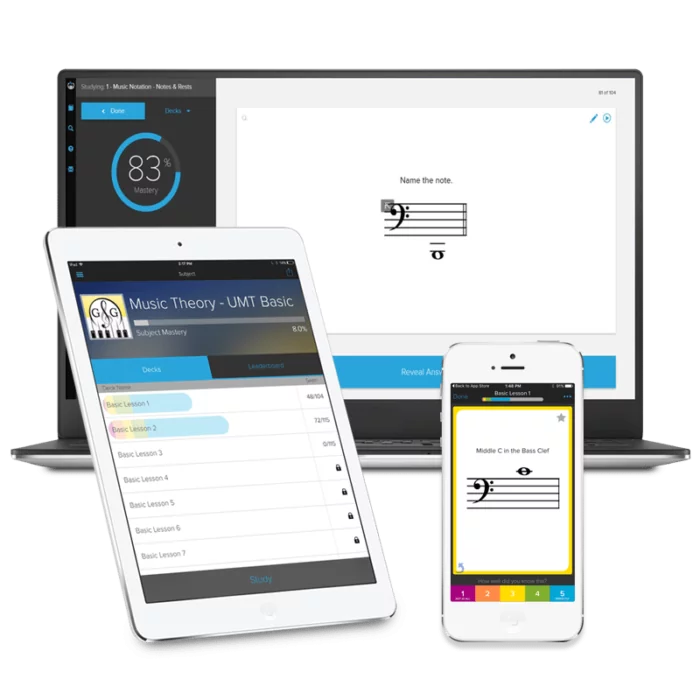
- LEARN FASTER – Use on any device, phone, tablet, computer
- EXPLORE – Identify written & audio notation
- PLAY – Sight Reading and Ear Training Games and much More!
Students will LOVE the UMT Flashcard System (App powered by Brainscape) that correlates to each lesson in the Beginner A, B, C, Prep 1, Prep 2, Basic, Intermediate & Advanced Workbooks.
Have fun building a foundation in Music Theory, Ear Training, and Sight Reading.
The One and ONLY Music Theory App & Matching Workbook!

Get Access To UMT Worksheets, Games, Activities, Posters, Certificates, Courses, Coaching Calls, Community & More!
Ultimate Music Teachers Membership
♪ LEARN ♪ PLAN ♪ TEACH ♪ GROW
The One & ONLY Ultimate Music Teachers Membership
To Become A UMT PRO!
Your Success Path Starts Here - Go To TeachUMT.com Today!

Ultimate Music Theory Certification Elite Educator Program - Online Teacher Training to Elevate Your Income, Impact Your Teaching and Grow Your Expert Music Teaching Business. Get Certified!
Click HERE to discover what you will learn in the Ultimate Music Theory Certification Course. Your professional development Online Teacher Training starts here!
Keep on Learning... With a Smile and a Song!
Shelagh McKibbon-U'Ren